
India’s javelin throw at the Glasgow Commonwealth Games produced a late twist as Yashvir Singh surged from seventh place to claim the bronze medal, crediting a last-second technical cue from Olympic champion Neeraj Chopra for the throw that changed everything. Yashvir said Chopra’s simple instruction—delivered just before his final attempt—helped him find the alignment he needed to produce a personal-best 85.41m and secure India’s second javelin medal at CWG 2026.
After the penultimate round, Yashvir’s best was 81.33m and he sat seventh, while South Africa’s Douw Smit held third with 82.88m. Then came the final throw: Yashvir delivered 85.41m, jumping into the medals and turning a difficult competition into a breakthrough moment.
From seventh to the podium: the final-round swing
Yashvir framed the medal as a product of staying composed through a challenging meet and then executing when it mattered most. “I had to overcome the adverse conditions,” he told PTI, describing how Chopra motivated him before the last throw and offered a specific technical reminder.
According to Yashvir, Chopra’s message was clear: keep the javelin “in one line.” The advice proved decisive as Yashvir’s final attempt not only surpassed his earlier best by more than four metres, but also cleared the mark that had been holding the bronze position. With Smit at 82.88m in third after the penultimate round, Yashvir’s 85.41m moved him into the top three and delivered the bronze.
Yashvir said the Glasgow meet was among the biggest tournaments of his career and that his focus was on effort and chasing a personal best. “This was one of the biggest tournaments of my life, so my only aim was to give my 100 per cent effort and leave nothing behind. I wanted to produce my personal best there,” he said. “I am happy that I achieved a personal best of 85.41 metres and also won the bronze medal with that performance.”
What “one line” meant in Yashvir’s words
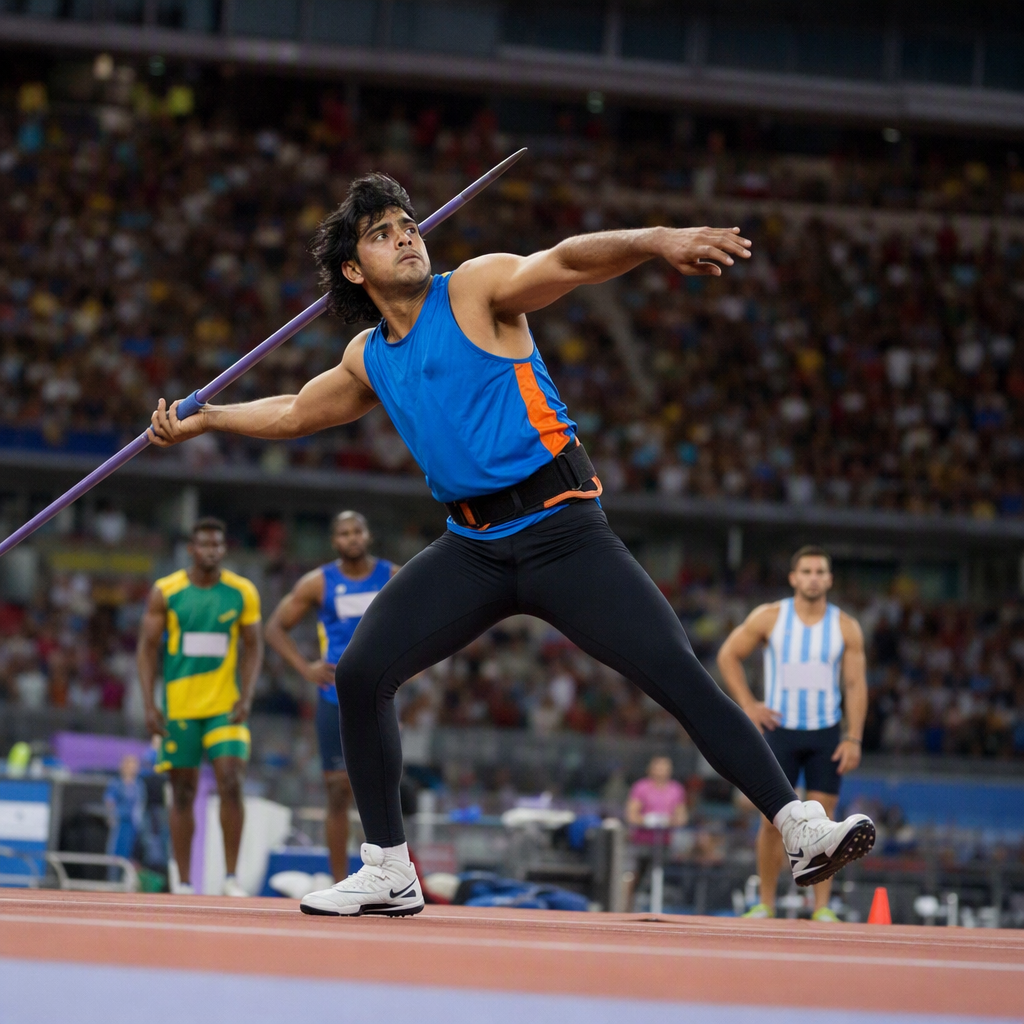
Yashvir also explained what he understood by Chopra’s instruction and how he applied it in the final attempt. He described it as holding the javelin near ear level, keeping his shoulders aligned in the direction of the throw, drawing back his arm and the javelin in a straight line, and releasing it over his shoulder along that same line.
The report noted that keeping the spear in one line—aligned with the shoulder—is an important technique in javelin because it helps maximise distance while reducing strain on the throwing arm. For Yashvir, the reminder arrived at the perfect time: with one throw left and a medal still within reach.
Pressure off, execution on: Yashvir on competing in a stacked field
Yashvir said he felt relatively free of pressure during the competition because the spotlight was on Chopra and other headline rivals, including Olympic and defending champion Arshad Nadeem, Sri Lanka’s Rumesh Pathirage and South Africa’s Anderson Peters. “I had no pressure as the focus was on Neeraj, Nadeem and Rumesh. I just had to give my 100 per cent effort,” he said.
That mindset, he added, helped him stay locked on the one goal he kept repeating to himself—hitting a personal best—until it finally came together in the last round. “I kept telling myself to achieve my personal best. God was kind and it happened,” he said.
Yashvir’s comments came after he received a hero’s welcome on his return from the Commonwealth Games at Delhi’s IGI Airport, reflecting the significance of the medal and the late-round comeback. With Chopra taking silver and Yashvir adding bronze, India left the event with two javelin medals—an outcome shaped not only by big throws, but also by a timely technical nudge that helped turn a seventh-place position into a podium finish.